
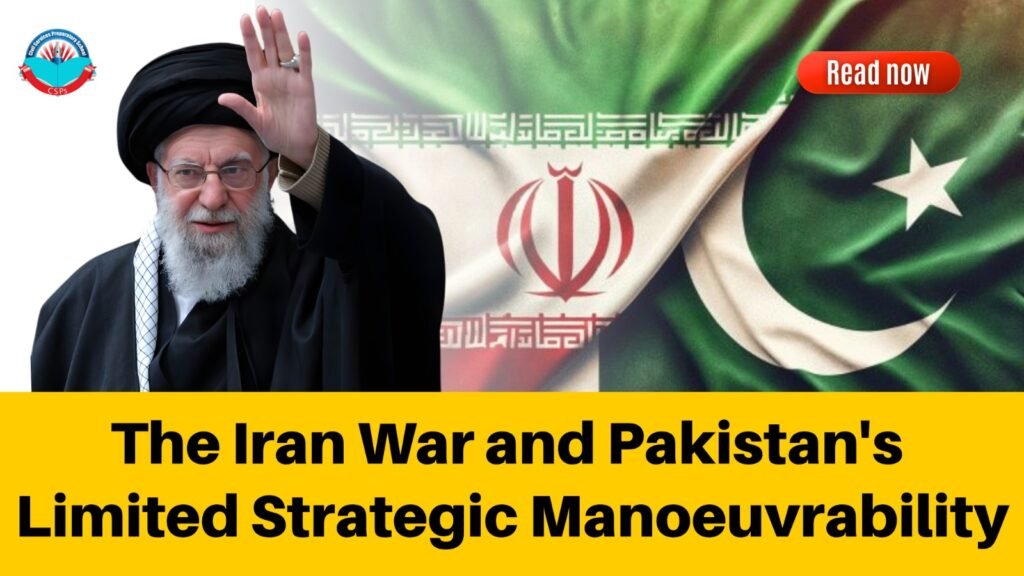
The Iran War and Pakistan’s Limited Strategic Manoeuvrability
Mr. Mureed Hussain Jasra
Abstract
The ongoing war involving Iran and Western allies has rapidly reshaped the geopolitical and economic landscape of the Middle East and beyond. Within the first ten days of the conflict, targeted strikes resulted in the assassination of Iran’s Supreme Leader, Ali Khamenei, along with several senior military officials. Contrary to expectations that such decapitation strikes would destabilize the Iranian state, Iran swiftly restored command and control through decentralised leadership structures and institutional continuity within its security apparatus. The rapid consolidation of authority prevented any visible leadership vacuum and fostered a surge of national unity across the country. Simultaneously, Iranian missile and drone attacks targeting neighbouring countries have created widespread fear and uncertainty across the Gulf. A critical development in the conflict has been Iran’s blockade of the Strait of Hormuz, a strategic maritime chokepoint responsible for a significant portion of global oil and gas shipments. The closure has already triggered a sharp rise in fuel prices, disrupted shipping routes, and intensified global energy market volatility. These developments have far-reaching implications for Gulf economies, tourism, and foreign investment, which historically relied on perceptions of regional stability. For Pakistan, the crisis presents multidimensional challenges including energy security risks, potential disruptions to remittances from Pakistani workers in Gulf states, and domestic political sensitivities linked to sectarian dynamics. The study also evaluates the implications of the Strategic Mutual Defence Agreement (SMDA) signed between Pakistan and Saudi Arabia on 17 September 2025 in the context of evolving regional security dynamics. By analysing economic, geopolitical, and societal consequences of the ongoing war, this paper highlights emerging strategic risks and outlines policy considerations for Pakistan.
Introduction
The Middle East has entered a period of intense strategic instability following the outbreak of direct hostilities involving Iran and Western allies. Within the first ten days of the war, coordinated airstrikes targeted senior Iranian leadership compounds, resulting in the assassination of the Iranian Supreme Leader and several high-ranking military commanders. These strikes were widely interpreted as an attempt to dismantle Iran’s command structure and weaken its strategic response capabilities.
However, contrary to initial expectations, Iran demonstrated significant institutional resilience. Rather than descending into political chaos or military fragmentation, the country rapidly restored operational command through an alternative leadership structure within its political and military institutions. The swift consolidation of authority prevented a command vacuum and reinforced domestic unity.
The war has already produced major geopolitical and economic repercussions. Iran’s retaliatory missile and drone operations against neighbouring countries have heightened regional insecurity, while the blockade of the Strait of Hormuz has disrupted global energy flows and triggered a surge in fuel prices. These developments have raised concerns about the stability of Gulf economies, global trade routes, and the energy security of countries heavily dependent on Middle Eastern oil supplies.
For Pakistan, the crisis is particularly significant due to its strong economic and strategic ties with Gulf states. Pakistan’s reliance on energy imports passing through the Strait of Hormuz, its large expatriate workforce in Gulf countries, and the evolving strategic relationship with Saudi Arabia make the conflict highly consequential for Islamabad’s economic and foreign policy priorities.
Iran’s Leadership Decapitation and Institutional Resilience
The assassination of Iran’s Supreme Leader and several senior commanders represented one of the most dramatic escalation points in the early stages of the conflict. Historically, leadership decapitation strategies have often been used in warfare to destabilize adversaries by targeting their political and military leadership structures.
In Iran’s case, however, the strategy failed to produce the anticipated collapse of command and control. Within a short period, the Iranian political system activated contingency leadership mechanisms designed to maintain continuity during crises. Senior members of the Iranian security establishment, particularly within the Islamic Revolutionary Guard Corps (IRGC), assumed operational responsibilities while political institutions coordinated administrative continuity.
Observers have described the emerging leadership structure as an “invisible leadership network,” reflecting the decentralized nature of decision-making during wartime conditions. This structure has enabled Iran to maintain operational coherence despite the loss of its highest leadership figures.
Furthermore, the assassination appears to have strengthened domestic unity within Iran. National sentiment intensified in response to external attacks, generating a rally-around-the-flag effect among the Iranian population and political elites. Instead of weakening the state, the attacks reinforced Iran’s determination to resist external pressure.
Missile and Drone Attacks and Regional Fear
Following the assassination of its leadership, Iran launched a series of retaliatory missile and drone attacks targeting military facilities and strategic infrastructure in neighbouring countries across the Gulf region. These attacks demonstrated Iran’s continued military capabilities and its willingness to project power beyond its borders despite leadership losses.
The strikes generated widespread concern among Gulf states hosting Western military bases or participating in regional security partnerships. Governments across the region elevated their security alerts, strengthened air defence systems, and restricted certain airspace corridors due to the risk of further attacks.
Although the physical damage from some of these attacks was limited, the psychological impact has been substantial. The perception that missile and drone warfare could reach key economic hubs has heightened uncertainty among regional populations and investors.
Closure of the Strait of Hormuz and Global Energy Disruption
One of the most consequential developments in the conflict has been Iran’s decision to block the Strait of Hormuz. This narrow waterway connects the Persian Gulf with global shipping lanes and serves as a critical route for international energy trade.
A large proportion of the world’s oil and liquefied natural gas exports pass through the Strait each day. Its closure has therefore had immediate consequences for global energy markets. Oil tanker traffic has sharply declined, shipping companies have suspended operations due to security risks, and insurance costs for maritime transport have increased significantly.
As a result, global oil prices have surged, triggering ripple effects across energy-dependent economies. The disruption has also forced Gulf producers to reconsider export logistics, as limited alternative routes exist to transport large volumes of oil outside the Strait.
Rising Fuel Prices and Global Economic Consequences
The disruption of energy supply chains has already produced significant economic consequences. Within days of the Strait’s closure, global fuel prices increased sharply as markets reacted to the sudden reduction in available oil supplies.
Higher fuel prices affect multiple sectors of the global economy. Transportation costs for shipping, aviation, and logistics increase immediately, raising the price of imported goods and commodities. Industrial production costs also rise as energy-intensive sectors face higher operational expenses.
In addition, rising energy prices often contribute to broader inflationary pressures. Food production, manufacturing, and supply chains all rely heavily on fuel and electricity, meaning that higher energy costs can spread across entire economies.
Financial markets have also reacted to the uncertainty generated by the conflict. Investors typically view geopolitical instability as a risk factor, leading to volatility in stock markets and fluctuations in currency values.
Economic and Tourism Impacts on Gulf States
The conflict has also affected Gulf economies that traditionally relied on perceptions of stability and security to attract tourism, investment, and global business operations. Cities such as Dubai, Abu Dhabi, and Doha have developed global reputations as safe and modern economic hubs.
However, the recent missile and drone attacks targeting nearby infrastructure have introduced new security concerns. Even if the attacks do not directly strike major urban centres, the perception of regional instability can influence travel decisions, business operations, and investor confidence.
Tourism industries across the Gulf may face declining visitor numbers if travellers perceive the region as unsafe. Airlines, hotels, and hospitality sectors could therefore experience economic losses if the conflict persists.
Similarly, foreign investment flows may slow as international investors reassess geopolitical risks associated with large-scale projects in the region.
Pakistan’s Strategic Vulnerabilities
Energy Dependence
Pakistan is particularly vulnerable to disruptions in the Strait of Hormuz because an overwhelming share of its imported energy supplies transits this narrow maritime chokepoint. According to recent estimates, around 70 % of Pakistan’s crude oil and nearly all of its liquefied natural gas (LNG) imports are shipped via the Strait of Hormuz, since the country imports virtually all of its LNG and a large portion of its petroleum products from Gulf suppliers whose tankers must pass through this route. Oil and gas imported through Hormuz are essential for power generation, transportation, and industrial activity in Pakistan, given that domestic hydrocarbon production is limited.
If a blockade or prolonged disruption of the strait continues, Pakistan may be forced to seek alternative supply routes or new suppliers; however, these would involve longer shipping distances and significantly higher freight and insurance costs, which would raise the overall cost of imported fuel. Higher import costs would likely translate into increased domestic fuel prices, upward adjustments in electricity tariffs, and broader inflationary pressures throughout the economy, further straining household budgets, business operating costs, and the balance of payments.
Pakistani Workforce in the Gulf
Millions of Pakistanis working abroad are among the country’s most important sources of foreign exchange, with a particularly large concentration in the Gulf Cooperation Council (GCC) states. According to State Bank of Pakistan (SBP) figures and related media reports, there are over 5.5 million Pakistanis employed across Gulf countries — including Saudi Arabia, the United Arab Emirates (UAE), Oman, Qatar, Kuwait, and Bahrain — making the GCC one of the largest expatriate labour destinations for Pakistanis globally.
These workers remit substantial amounts of money back home, helping sustain household incomes and providing a critical cushion to Pakistan’s balance of payments. In the fiscal year 2024–25, Pakistan’s total workers’ remittances reached a record $31 billion overall, with Saudi Arabia alone sending about $9.34 billion and the UAE around $7.83 billion; other GCC countries (such as Kuwait, Qatar, Bahrain and Oman) collectively sent approximately $3.71 billion. Taken together, remittances from GCC countries accounted for a large portion — roughly half or more — of the total $31 billion recorded in FY 2024-2025, underscoring how much Pakistan’s foreign exchange inflows depend on its Gulf workforce.
An economic slowdown or instability in these Gulf economies could therefore significantly reduce employment opportunities and remittance inflows, with adverse effects on Pakistan’s external accounts and overall economic stability.
Sectarian Sensitivities and Domestic Reactions
Regional conflicts involving Iran often carry sectarian dimensions, as Iran positions itself as a leading Shia power among Muslim countries. In Pakistan, these developments can influence domestic political discourse, shape public sentiment among various religious communities, and affect the policymaking environment.
Historically, crises in the Middle East—such as the Gulf Wars, the 2003 Iraq invasion, and tensions in Syria—have at times triggered protests, demonstrations, and mobilization by religious and political groups within Pakistan, reflecting both solidarity and dissent. These reactions underscore how international conflicts do not remain confined to their immediate regions but can reverberate through domestic politics, impacting social cohesion, political alignments, and public debates on foreign policy.
Such external crises often coincide with spikes in sectarian rhetoric and political activism in Pakistan that have been seen in the Karachi mob attack on the US. Consulate and destruction of Public and government properties in major cities of Pakistan, highlighting the intertwined nature of regional geopolitics and internal dynamics.
Pakistan–Saudi Arabia Strategic Mutual Defence Agreement
In September 2025, Pakistan and Saudi Arabia signed the Strategic Mutual Defence Agreement (SMDA), a landmark accord aimed at enhancing defence cooperation, intelligence sharing, and strategic coordination between the two countries. This agreement underscores the long-standing security partnership between Islamabad and Riyadh and comes at a time of heightened regional tensions, particularly amid the ongoing conflict involving Iran and Western allies. The SMDA could shape joint military planning, facilitate coordinated diplomatic consultations, and reinforce Pakistan’s role as a security partner in the Gulf. However, Islamabad faces the delicate task of balancing its commitments to Saudi Arabia with its historically significant relations with Iran, as deepening ties with Riyadh could risk entangling Pakistan in broader regional rivalries. According to the Stockholm International Peace Research Institute (SIPRI), Pakistan’s defence exports and military cooperation with Gulf states have grown by over 12% since 2023, reflecting a trend toward strengthening strategic alliances while maintaining regional equilibrium.
Policy Implications for Pakistan
The ongoing conflict involving Iran and Western allies has produced wide-ranging geopolitical, economic, and security repercussions across the Middle East and beyond. Despite the targeted assassination of senior Iranian leadership, Iran has demonstrated significant institutional resilience, maintaining operational command structures and continuing its regional military activities.
The escalation has included frequent missile and drone attacks across neighbouring countries, as well as disruptions to shipping and energy transit due to the partial blockade of the Strait of Hormuz, which handles nearly 20% of global oil trade, creating acute uncertainty in international energy markets.
Gulf states face mounting economic pressures, including threats to tourism, foreign investment, and regional stability, while Pakistan is particularly vulnerable to disruptions in trade, energy supplies, and security dynamics along its western border.
The Strategic Mutual Defence Agreement (SMDA) signed between Saudi Arabia and Pakistan on September 17, 2025, aims to enhance bilateral cooperation in defence, intelligence sharing, and counterterrorism, providing a framework for collective regional security.
Moreover, the conflict is likely to affect global supply chains, foreign policy alignments, and the internal political economies of countries in the region, emphasizing the urgent need for diplomatic engagement, crisis management, and multilateral coordination to prevent further escalation and stabilize the Gulf.
Conclusion
The ongoing war involving Iran and Western allies has produced far-reaching geopolitical and economic consequences. Despite the targeted assassination of its senior leadership, Iran has demonstrated institutional resilience, maintaining effective operational command structures. Concurrently, missile and drone attacks across the region, coupled with the blockade of the Strait of Hormuz, have generated widespread uncertainty in global energy markets, affecting both oil supply and investor confidence. Gulf states face significant risks to tourism, foreign investment, and overall economic stability as regional tensions persist.
For Pakistan, the crisis poses serious challenges, particularly in the areas of energy security, remittances from abroad, and domestic political dynamics. The long-term implications of this conflict will largely depend on the duration of maritime disruptions, the capacity of regional economies to absorb shocks, and the effectiveness of global actors in managing escalation while safeguarding vital economic interests. Policymakers and businesses alike must navigate this volatile environment cautiously, as the evolving situation continues to reshape regional and international economic landscapes.
The author, Mr. Mureed Hussain Jasra, is a civil servant, educator, and researcher with a strong interest in international relations, strategic studies, and public policy. He is also the author of widely recognised books and actively contributes to intellectual discourse through research and teaching. Alongside his public service career, he has been engaged in teaching and academic activities, focusing on contemporary global affairs, governance, and policy development